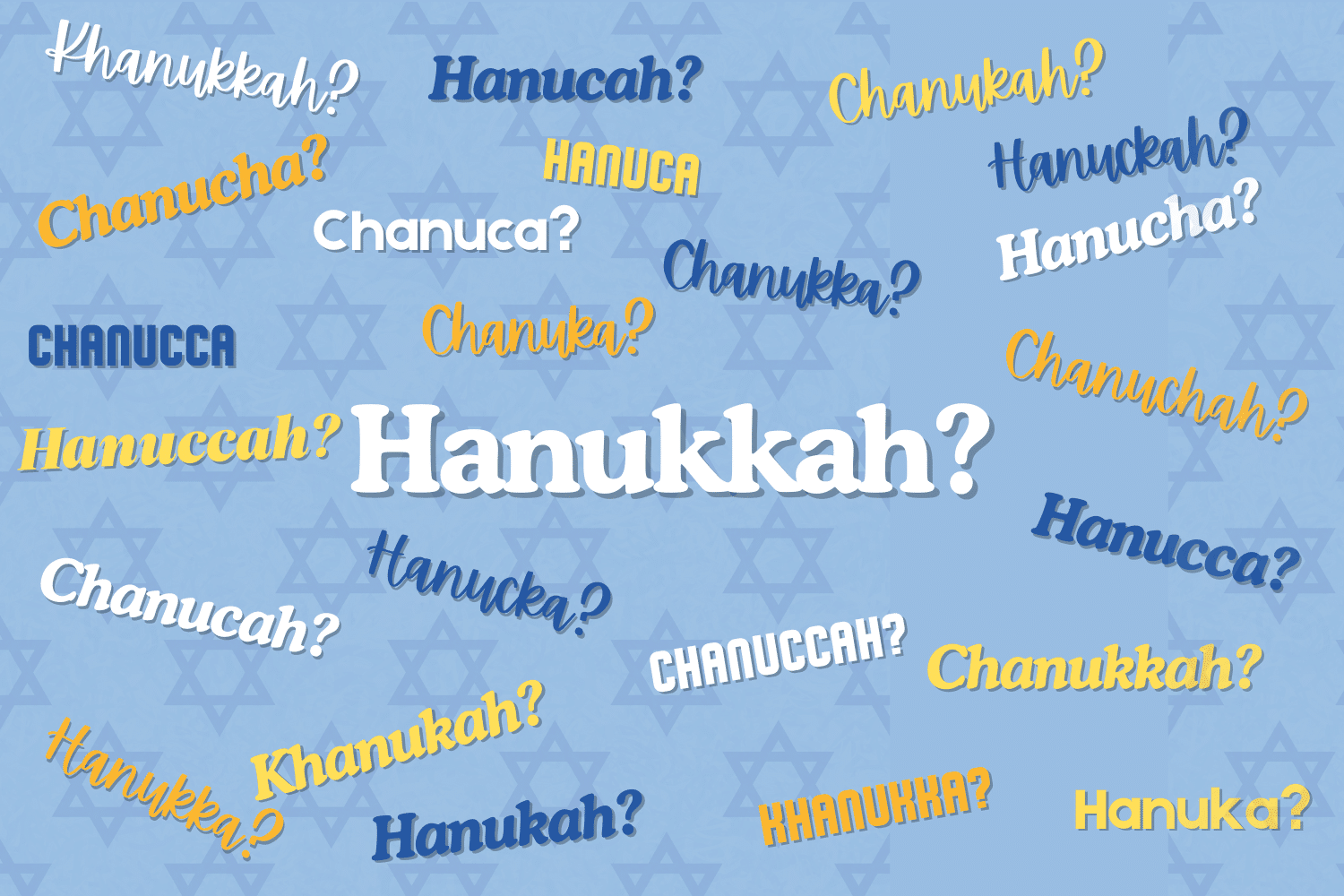
You're standing in the greeting card aisle. You’ve got a pen in your hand and a blank card for your neighbor, but your brain suddenly freezes. Is it an "H" or a "Ch"? Does it end with an "h"? Do I double the "n" or the "k"? Honestly, it's one of the most common holiday anxieties out there. The short answer to how do I spell Hanukkah is pretty simple: however you want, as long as it sounds right.
That sounds like a cop-out, doesn't it? It isn't.
Because the word isn't English, there is no "correct" spelling in our alphabet. We are basically trying to take a Hebrew word—חֲנוּכָּה—and force it into Roman letters that don't quite fit the sounds. It's called transliteration. It’s messy. It’s confusing. And it’s why your phone's autocorrect probably fights with you every single December.
The Battle Between Hanukkah and Chanukah
If you look at the data from the Oxford English Dictionary or the Associated Press (AP) Stylebook, you'll see a clear winner for the most popular version. Hanukkah is the big one. It’s the version you’ll see in the New York Times and on most Starbucks gift cards. But if you walk into a traditional Jewish home or a synagogue, you might see Chanukah more often.
Why the "Ch"?
In Hebrew, the word starts with the letter Chet. This letter doesn't sound like the "ch" in "chocolate" or "cheese." It’s a guttural, scratchy sound made in the back of the throat. Linguists call it a voiceless uvular fricative. Think of the sound in the Scottish "loch" or the German "Bach." Since English doesn't have a single letter for that sound, early translators used "Ch" to represent it.
Eventually, people got tired of sounding like they were clearing their throat. Or, more accurately, English speakers who weren't Jewish didn't know how to make that sound and just started saying "Hanukkah" with a soft "H." Over time, the spelling shifted to match the pronunciation. By the mid-20th century, the "H" spelling started overtaking the "Ch" version in mainstream American media.
It's All About the Transliteration
Let’s look at the anatomy of the word. The Hebrew word is spelled Cheit, Nun, Vav, Kaf, Hey.
When we ask how do I spell Hanukkah, we are really asking how to map those five Hebrew characters onto our 26 letters.
The first letter (Cheit) gives us the H vs. Ch debate. The middle part is where the real chaos happens. In Hebrew, some letters can have a "dagesh"—a little dot in the middle that changes how the letter is emphasized. The letter Kaf in the middle of the word has one of these dots. This suggests a "doubling" of the sound. This is why some people insist on two 'k's (Hanukkah) while others think one is just fine (Hanukah).
Then there’s the ending. The letter Hey at the end of the Hebrew word is often silent but acts as a vowel marker. In English, we usually represent that with an "h" (Hanukkah), but some people prefer to drop it (Hanukka).
If you do the math on all these variations—H vs. Ch, one N vs. two, one K vs. two, ending with H or not—you end up with over 20 possible combinations. They are all technically "correct" because they are all just phonetic approximations of a language that doesn't use our alphabet.
What the Experts Say (And Why They Disagree)
Dictionary publishers have been trying to pin this down for a century. Merriam-Webster lists Hanukkah as the primary spelling but acknowledges Chanukah as a very common variant.
The Library of Congress prefers Hanukkah.
The Jewish Telegraphic Agency (JTA), which is basically the AP of Jewish news, used to use Chanukah for decades before finally switching to Hanukkah to match search engine trends. This is a big deal. When a major cultural news organ changes its spelling, it signals a shift in the "standard."
But traditions die hard. Many families have used the "Ch" spelling for generations. It feels more "authentic" to many because it acknowledges that unique Hebrew sound. Using the "H" can feel a bit like the "Americanized" or "sanitized" version.
The Most Popular Variations
- Hanukkah: The undisputed heavyweight champion of SEO and modern journalism.
- Chanukah: The traditionalist's choice.
- Hannukah: A common mistake, doubling the 'n' instead of the 'k'.
- Hanuka: Simplified, but less common.
- Channukah: For people who want both the traditional start and the doubled middle.
Interestingly, the spelling "Hanukkah" started gaining massive steam in the 1970s. Before that, "Chanukah" was actually the dominant form in English-language books. You can see this clearly if you look at Google's Ngram Viewer, which tracks words in printed books over centuries. The lines crossed somewhere around 1980.
Does the Spelling Actually Matter?
Not really.
Unless you're writing a formal academic paper or work for a newspaper with a strict style guide, no one is going to call the Spelling Police. If you're sending a card, the sentiment matters more than the number of "k"s.
However, if you are searching for recipes or history online, how do I spell Hanukkah becomes a functional question. Using the most popular spelling—Hanukkah—will give you the most search results. If you search for "Chanukah," you might find more "inside baseball" content, traditional recipes from older Jewish organizations, or more religious-leaning commentary.
It’s a bit like searching for "cats" versus "felines." One is the common name, the other is a bit more specific or formal.
The Meaning Behind the Mess
Hanukkah means "dedication."
It refers to the rededication of the Second Temple in Jerusalem during the second century B.C. After the Maccabean Revolt against the Seleucid Empire, the Jewish people found only enough ritual oil to light the Temple's menorah for one day. Miraculously, it lasted for eight.
That’s why the holiday is eight days long.
When you get caught up in the spelling, it’s helpful to remember that the word itself is about resilience and reclaiming identity. Whether you start it with a C or an H, you’re talking about the same Festival of Lights.
A Practical Guide to Picking Your Spelling
If you’re still undecided, here is a quick rule of thumb based on context.
Use Hanukkah when:
- You are writing a business email.
- You are posting on social media for a broad audience.
- You want to ensure your Google search gives you the most results.
- You are buying a generic store-bought decoration.
Use Chanukah when:
- You are writing to someone who is very observant or traditional.
- You want to emphasize the Hebrew roots of the word.
- You are writing for a specific Jewish publication that uses this style.
Avoid these (unless you just like being different):
- Xanuka (It exists, but people will be confused).
- Hannukkah (Too many double letters).
- Hanukka (Looks a bit naked).
Why Autocorrect Still Hates You
Ever notice how your phone puts a blue or red line under your choice no matter what? That’s because even software engineers can't agree. Apple, Google, and Microsoft all have slightly different internal dictionaries.
In 2026, most predictive text systems have finally defaulted to "Hanukkah." But if you have a friend named "Chana" or you frequently type other Hebrew-derived words starting with "Ch," your phone might learn your preference and stop bothering you.
Final Insights for Your Holiday Writing
When you sit down to write your cards or captions this year, don't overthink it. The variety in spelling is actually a beautiful reflection of the Jewish Diaspora—different communities in different parts of the world developed their own ways of bringing their language into the English-speaking world.
Actionable Steps for Correct Usage:
- Pick one and stick to it. Consistency is more important than which version you choose. Don't use "Hanukkah" in the first paragraph and "Chanukah" in the second.
- Check your audience. If you're writing for a specific organization, look at their website's "About" page to see which version they prefer.
- Use the H-spelling for SEO. If you're a blogger or business owner, "Hanukkah" is searched significantly more often than any other variation.
- Don't correct others. If someone sends you a "Happy Hannukah" text, don't be that person who explains transliteration. Just say "Happy Hanukkah" back.
The linguistic "right way" doesn't exist. There is only the "preferred way" for your specific situation. Go with Hanukkah for the widest appeal, or Chanukah for a nod to tradition. Everything else is just icing on the sufganiyot.