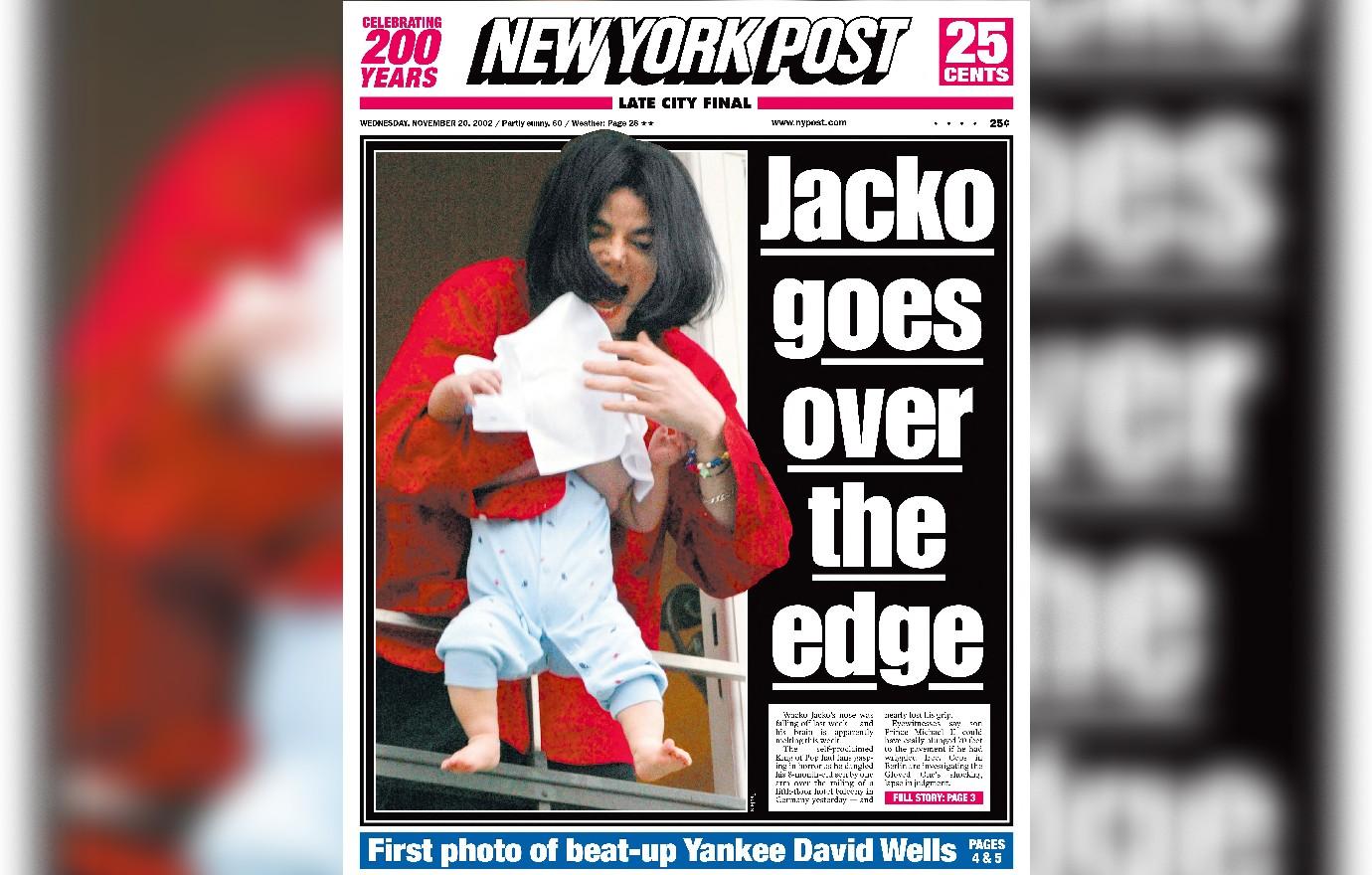
It was only a few seconds. That’s all it took to change the narrative of a career that was already under an intense, almost microscopic level of public scrutiny. In November 2002, outside the Hotel Adlon in Berlin, the world watched a moment that felt like it defied logic. Michael Jackson, the undisputed King of Pop, stood on a fourth-floor balcony and held his nine-month-old son, Prince Michael II—affectionately known as "Blanket"—over the railing.
The image was jarring.
The flashbulbs were constant, a rhythmic thumping of light against the gray German sky. Thousands of fans were screaming below, a sea of people chanting his name, desperate for a glimpse of the man who had become more myth than human. In that chaotic environment, Jackson wanted to show his youngest child to the crowd. He’d done it before with his older children, but always with their faces covered. This time, the sheer height and the way he gripped the infant sparked a global firestorm.
Honestly, it’s one of those "where were you" moments for pop culture junkies. You see the footage today and it still creates a physical reaction in your gut. It wasn't just a celebrity gossip story; it became a debate about parenting, safety, and the mental state of the most famous person on the planet.
Why the Michael Jackson blanket balcony moment still haunts his legacy
To understand why this mattered so much, you have to look at the context of 2002. Michael wasn't just a singer anymore; he was a lightning rod for controversy. He was in Berlin to accept a Bambi Award for his philanthropic work, yet the "balcony incident" completely overshadowed the honors.
The press went into an absolute frenzy. Newspapers across the globe ran the photo on the front page with headlines that questioned his fitness as a father. It wasn’t just the tabloids, either. Serious news outlets spent days analyzing the physics of his grip and the height of the drop. People were genuinely terrified for the baby.
Jackson later released a statement through his publicist, and he didn't mince words about his own regret. He called it a "terrible mistake" and admitted he got "caught up in the excitement of the moment." He insisted he would never intentionally endanger the lives of his children. But for many, the damage was done. It fed into the "Wacko Jacko" narrative that the British tabloids had been building for nearly two decades.
It's kinda wild how one lapse in judgment can become a permanent stain. Despite the fact that his children—Prince, Paris, and Bigi (formerly Blanket)—have all grown up to speak incredibly highly of his parenting, that one video clip remains the go-to visual for critics.
The logistics of the Hotel Adlon
The Hotel Adlon Kempinski is one of the most prestigious hotels in the world. It sits right next to the Brandenburg Gate. The balconies aren't exactly flimsy, but they are high. If you’ve ever stood on a fourth-floor balcony, you know that a drop from that height is almost certainly fatal for an infant.
Fans had been camped out for days. The energy was electric, bordering on dangerous. When Michael stepped out, the noise was deafening. He held the baby with one arm while the child's head was covered with a cloth—hence the nickname. Then, he briefly extended the child over the metal railing.
The footage shows Michael pulling the baby back quickly, almost as if he realized the gravity of the situation the moment he did it. He waved to the fans one last time and retreated into the suite. Inside that room, away from the cameras, the atmosphere must have been incredibly tense.
The immediate fallout and legal threats
The repercussions weren't just social. They were legal. In the United States, child welfare advocates called for investigations. People were asking if the authorities in California should step in.
Gloria Allred, the high-profile attorney known for taking on celebrity cases, actually wrote to California’s Child Protective Services. She urged them to look into the safety of Jackson's children at Neverland Ranch. It was a massive headache for Jackson's legal team, which was already bracing for what would eventually become the 2005 trial.
In Germany, the police also had to weigh in. A spokesperson for the Berlin police eventually stated that they weren't investigating because no complaint had been filed and the child didn't appear to be in "immediate danger" in a way that violated German law after the fact. Basically, they saw it as a momentary lapse rather than a pattern of abuse.
Still, the court of public opinion was much less forgiving.
What Blanket (Bigi) says about it now
The baby in that video is now a man in his early twenties. He goes by Bigi Jackson now and is famously private. Unlike his older siblings, Paris and Prince, who have spent more time in the limelight, Bigi stays in the background.
However, when he has spoken, it’s never about the balcony. He talks about his father's passion for the environment and his legacy as an artist. It’s a strange dichotomy. The world sees a "victim" of a balcony stunt, but the person actually involved sees a father who was protective to a fault.
The kids have often explained that the masks and veils weren't about being "weird." They were about privacy. Michael wanted them to be able to go to a movie or a park without him and not be recognized. He wanted them to have the childhood he never had. The balcony incident was the one time that protective instinct backfired spectacularly.
Analyzing the media's role in the frenzy
The media didn't just report on the Michael Jackson blanket balcony event; they looped it. If you turned on CNN or MTV in late 2002, you saw that five-second clip on a literal 24-hour cycle.
It was the perfect "outrage" content before social media even existed. It had everything:
- A world-famous superstar.
- A vulnerable infant.
- A high-stakes environment.
- A visual that didn't need translation.
Journalists like Martin Bashir used moments like this to frame their documentaries. Bashir was actually filming with Michael around this time for the infamous Living with Michael Jackson documentary. He used the balcony incident as a pivot point to ask deeper, more intrusive questions about Michael’s private life.
Looking back, there’s a lot of conversation about how the media treated Michael. Was he a victim of his own fame, or did he constantly provoke the fire? It’s probably both. He was a man who lived his life in a vacuum of "yes-men," which often meant no one was there to say, "Hey, Michael, maybe don't hold the baby over the railing."
The lasting cultural impact
Why do we still talk about this?
Because it represents the peak of celebrity culture’s obsession with the "train wreck." We live in a world now where celebrities are over-exposed on Instagram and TikTok, but back then, Michael Jackson was an enigma. When that enigma did something humanly flawed, it felt like a seismic shift.
It also changed how hotels handle celebrity stays. After the Adlon incident, security protocols for high-profile guests often included stricter rules about balcony access and public appearances to prevent "crowd-incited" stunts.
Actionable insights: Lessons in crisis management and perception
Whether you're a public figure or just someone navigating a messy situation, there are real takeaways from how this unfolded.
- Own the mistake immediately. Michael’s apology was swift. He didn't try to gaslight the public by saying he didn't do it. He admitted it was a mistake. While it didn't fix his reputation overnight, it stopped the "denial" cycle that usually makes these stories worse.
- Context matters, but optics win. You might have the best intentions—like Michael wanting to share his joy with fans—but if the optics look dangerous, the intention doesn't matter. In the digital age, a single frame is more powerful than a thousand-word explanation.
- The long game of parenting. The ultimate "proof" of Michael’s parenting wasn't found in a press release; it was found in his children. If you’re facing public criticism, sometimes the only way to disprove it is through the long-term results of your actions.
- Separate the art from the person. For fans, this was a turning point. Many had to decide if they could still love Thriller while being horrified by the balcony video. This was the precursor to the modern "cancel culture" debate.
The Michael Jackson blanket balcony incident serves as a grim reminder of the pressures of extreme fame. It was a moment where the boundary between a "performer" and a "parent" blurred in a way that was nearly catastrophic.
To really understand the legacy of Michael Jackson, you have to look at both the brilliance of his choreography and the tragedy of his isolation. He was a man who spent his life trying to be seen, yet often seemed terrified of what the world saw when they finally looked.
If you're looking to dive deeper into this era of pop culture, your best bet is to watch the unedited footage of his 2002 Bambi Awards speech. It provides a stark contrast to the balcony clip—showing a man who was genuinely trying to use his platform for good, even as his personal choices were pulling that platform apart. You can also research the "Home Movies" that Michael released himself in response to the Bashir documentary, which gives a more intimate, albeit controlled, look at his life with his kids during those turbulent years in the early 2000s.
Keep in mind that when researching this, you'll find a lot of conflicting "expert" opinions from that time. Always look for the primary sources—the actual police statements and the direct quotes from Jackson himself—to cut through the tabloid noise that still surrounds the Hotel Adlon to this day.